Thoughts 3 Years Post Grad from Art School
What I learned so far from making art into a job.

For context, let me introduce myself as I currently am! I’m an indie author and freelance illustrator who writes/illustrates YA/NA fantasy novels and also does character/cover illustration for other indie authors and the occasional book box like Illumicrate and LitJoy Crate. 2024 is my first full year of freelancing.
(Also privilege check: I’m debt-free with no dependents and no living expenses, as I’m still living with my parents. I’m very lucky in that regard! Not everyone has the leisure to worry about art like this, so I’m eternally grateful that I can.)
I graduated from my art school in 2022 with a degree in Digital Media with a focus on animation. By the way, I’m not an animator, never worked in the animation industry, and I never actually considered an animation career except for very briefly during school. (Long story short, it’s because I wasn’t in tune with what I wanted during my school days, and also the animation program in my school wasn’t the best lol.)
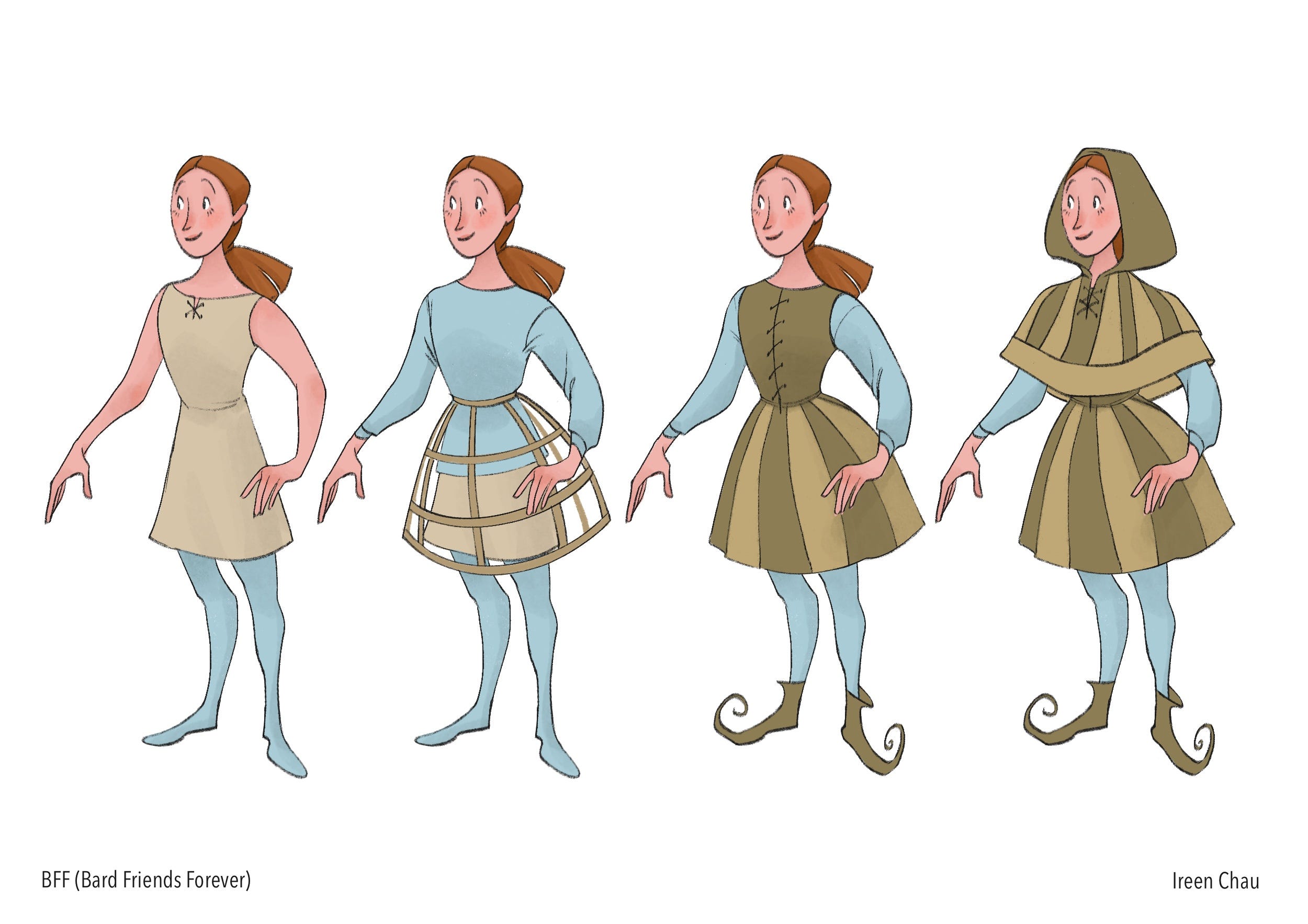
(A slide from a character design project from 2022)
Upon graduating, I had the realization that book illustration was a path better suited to me. But I was soon hired to be a concept artist at a tech startup. Despite not being able to start on my illustration path as I hoped, I was happy because I graduated with a “not-very-practical” major and managed to get hired right out of school with a pretty decent first-time salary, thereby proving “the starving artist” myth wrong.
Art is perhaps one of the most misunderstood things in the world. Even the word “art” is hotly debated over, especially when it comes to the modern interpretations of it. Personally, I’m not that concerned with what “Art with a capital A” means—it is subjective, and I’m okay with someone calling a blank square art if it makes them happy. If it isn’t for me, I just move on. (But what decidedly isn’t art is anything generated by AI, and I’ll die on that hill.)
While I was in school, I started to separate art as a skill from art as self-expression, because that is the one thing you must do if you want to be a commercial artist like I did. (Commercial, as in concerned with making a profit, which is what we’re all concerned with when we make art into a job.) I was very eager to do this because I wanted to prove that art is a legitimate career path like any other.
I remember starkly when one of the professors of my major came into our freshman class one day, asked which of us were majoring in Fine Art, and then laughed and said, “See you in McDonald’s!” to the students who raised their hands. Honestly, that was a wild and borderline unhinged thing to say to us kids—he was that type of professor, who was very callous and did not see that as a vice. But at the time I found that funny because I was locked and loaded, ready to be a commercial artist, not one of those starving fine artists. (Fine art is the stuff you see in galleries and museums—though I’m not too familiar with the inner workings of that industry.)
I think most people equate all art to fine art. They think art is this mystical, innate talent, an ephemeral and beautiful thing that you either can or can’t do, a thing that hangs on a museum wall that sometimes we don’t understand. But art is a skill—a craft that can be learned and monetized—which is why I’ll specify the type of art I’m talking about here, to solidify it and bring it back down to reality, portraying it as the very normal skill that I wished everyone could see it as. In my case, drawing and illustration.
Drawing is a skill. That is a fact. But what I choose to draw and how I choose to draw it is self-expression. The former is to monetize. The latter is just for me, to feed my soul.
The thing is, you can’t really keep these things completely separate, and I didn’t realize that.
Because what makes an artist’s work so compelling, so hire-able, is not only its technical excellence, but also the personal parts, the self-expression. I think self-expression and excellence go hand in hand. You can’t make good art if you’re not having fun with it, and you can’t be excellent at art if you don’t love it.
During my corporate concept artist job, I found that most of the work was rather monotonous, which I expected, so I was a little surprised to learn that with some projects, I was encouraged to be creative and brainstorm ideas on my own. I knew that hired artists, especially those in visual development or character design or concept art, are meant to bring some of their personal vision and creativity to serve a company’s project. But that was for “fun” jobs that had a lot of storytelling (games and animated films), not my job. The company I worked at mainly put out a fashion/character app (think Bitmoji but 3D) so there wasn’t really a “narrative” or “story” to attach myself to and be excited about.
It was not a bad first job at all, but after a while, I realized I was feeling a little dead inside. I always thought I would be okay with being a “mindless printer” type of artist, a worker bee—as long as I was drawing for a legit company, that was fine. And it was cool that I was encouraged to come up with my own ideas, right?
Actually, it wasn’t, because a huge part of my art and why I love drawing is the storytelling aspect of it and the personal part of it. It’s the designing of original characters and coming up with their backstories, of having full creative control. I didn’t love having to come up with ideas and use my creativity for a company whose goals and projects weren’t of interest to me. Drawing for them every day started feeling like pulling teeth, and I almost wished that I wasn’t encouraged to be creative, because the creativity part was supposed to be mine. I numbed myself to it for a time, treating it as normal, because that’s just how jobs are. That’s just how life is!
But y’all, hindsight, it sucked. It was bearable but it sucked.
In art school, I thought I was more than ready to set self-expression aside and use my skills for a company’s vision. I never considered that I would be an “artsy-fartsy” person, someone who, you know, cared so much about their art, because those were the people who ended up at McDonald’s! *Gasp*. (Nah but we really shouldn’t slander fast food workers like that, they go through enough and need to be paid more.)
After working in corporate for a short eleven months (I didn’t even make it to a full year before I got laid off abruptly), I realized that corporate artists are so overlooked and underappreciated, and it felt terrible. Those who work in animation are a blur of scrolling names in the credits no one stays in the theater for, if they end up in the credits at all. Game artists are even more obscure, unless you’re one of the big names. Cover artists are also difficult to find—their names are in 5 point font on the back of a book. Picture book artist get their names on the covers, at least, but no one knows exactly how much their art alone carries picture books. Everyone sees the art, the corporation, the author, but never the artist. So. It’s quite discouraging to give a company your creativity, a piece of your soul, in exchange for little else but money and very minimal job security. RIP the animation artists especially.
Don’t get me wrong, money is great, and so is healthcare *laughs in American*, but imagine trading away a little piece of yourself every day for years upon years upon years. I think this is more of a critique of capitalism than anything else (I know, I’m also rolling my eyes), but really, why do we spend so much of our life working and tie so much of our identity and worth to our careers?
When I was laid off, I was desperate to get another job to prove my legitimacy as a commercial artist, to prove that pursuing art was the “right” choice. I applied to more concept art jobs and wondered if I should get an illustration agent, but no luck! I had an 8 month crisis wondering what I was going to do.
It wasn’t until after those eight months did I finally found the guts to become a freelancer and give this whole indie author/freelance illustrator thing a shot. (Not mentioned earlier was that I wrote and illustrated 2 books during junior/senior year of art school and while I was working corporate, purely for fun, because I figured I should have a “backup hobby” if I wanted to make art a job. I always loved reading and writing fiction so this wasn’t totally out of the blue.)
2024 is almost over, which means it has almost been a full year of freelance and niching down to the type of art I really love doing, namely illustrating for YA books and also writing books itself, because writing is also art. I’ve learned that I am quite sentimental about my writing—I put so much of myself into it and am not afraid to admit it. But recently I realized I was treating my drawing and illustration as a dead thing, a cold skill, because I had spent so long suppressing the “artsy fartsy” part of me, the sentimental artist part, in an attempt to prime myself for the art industry.
I admit I went a little overboard taking commissions this year, and even though they were book cover illustrations and character art and objectively more fun than the stuff I was doing in corporate, it still felt a little terrible, because I was overworking myself and burning myself out, still chasing the legitimacy a good salary would bring me. I did not want to draw for a while this year. Every time I picked up a pencil, it was for a commission or for a book illustration, never for fun. As a result, the quality of my art both plummeted and stagnated, which was a disservice to both me and my clients. I was also getting the same type of commission (illustrations of two characters in a generic romantic pose) which made sense because I’ve done a fair bit of that. But the repetitive nature of these pieces allowed little room for curiosity or experimentation, which are integral parts of improving and keeping my joy for the craft alive.
A couple months ago, I decided that I needed to take a step back from commissions, brush up on the basics, and start sketching for fun again, which I have! It has honestly been a relief and I’m starting to rekindle my joy for drawing. You can follow me here or on my IG to see the sketches I’m doing.
Meanwhile, I’m beginning to reel back a little on my writing, telling myself that it doesn’t need to be that serious and that I’m not here to write great literature. Monetizing my art has been a delicate balance of keeping it close to my heart and holding it at arm’s length. It’s a push and pull, and I’m not careful, that balance can be disrupted.
If you’re considering art as a career, this is definitely something to think about. But it’s alright if you don’t know exactly what you want yet, because I didn’t, and I’m still figuring things out.
Anyway, I never really had a space of my own to yap about art like this and I’m planning to dump all my art/writing thoughts here. If you made it this far, thanks for reading and I hope you stay for future rambles!
Ireen I graduated in 2019 with a Fine Art degree, and I resonate alot with this post! I worked three days for a power bill company after college and it was that “dead inside feeling” I honestly couldn’t do it!
I have been freelancing ever since! Even so, it’s taken me several years to realize I could tell my own stories without a big company. (My delulu college-self wanted to be a concept artist or character designer.) 🤣
✨The point is, in the short time I have followed your work you have made leaps of progress! All of your books have inspired me to advocate for my own stories along side commissions! And I am sure I am not the only artist inspired by you! So keep rambling!